


Welcome to Seeds of a Second Renaissance - a monthly newsletter for explorers of inner-led change towards radically wiser societies. For both seasoned travellers and those new to these shores, each edition offers a bite-sized exploration of keystone ideas, and introduces thinkers whose work you may wish to know more deeply.
This month is a little different. We’d like to share a new essay from the Second Renaissance series - addressing a force that shapes not only our material conditions, but the deepest foundations of modern culture: technology.
We reflect on tech as a modern God, its entanglement with our prevailing worldview, and the shift in human capacities and meaning-making that could help us relate to it more wisely. It’s the fifth paper in the series; authored by Rufus Pollock, Rosie Bell and Sylvie Barbier (Life Itself Sensemaking Studio).
We hope you’ll find it useful to explore the essay’s core themes - with an invitation to go ahead and dive into the full paper.
Below, you’ll also find curated events, jobs, and opportunities.
In Tech We Trust
Co-evolving with our tools
Humans have co-evolved with tools and techniques that shape our bodies, behaviours, and societies: from fire to clothing, literacy and weapons.
Nonetheless something does feel different about the age we’re living in. The speed and scale of tech. The irreversibility of its influence. New life-altering tools emerge and embed themselves faster than sense-making can follow. By the time we’re beginning to understand an innovation, it’s often so entrenched in our psychology and economy that we don’t know how to undo it even if we wanted to.
The widening wisdom gap between what we are empowered to do with tech and what we can do wisely is an existential threat; touching climate, information ecosystems, mental health, geopolitics… and now AI.
What follows isn’t a moral condemnation of tools, engineers, or innovation. It’s a diagnosis of a cultural paradigm shaped in the image of technology itself: prizing measurement over meaning, material progress over discernment, and competition over collective care, even as these habits pull us towards a precipice.
Technology as God
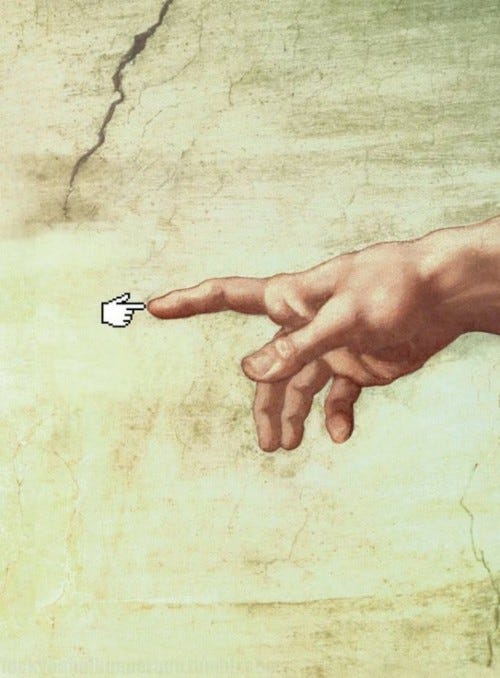
Modern society increasingly relates to technology as a surrogate god. Tech isn’t an explicit object of worship, but we trust, revere, defer to, and organise our lives around it. In a secular age where religion has lost its central status as collective authority, technology and its priesthood have inherited a surprising number of divine functions…
In tech we trust
Normalising smartphone addiction, we give technology permission to shape our attention, behaviour, and sense of reality. We allow algorithmic systems to curate perception, mediate relationships, and steer political life.
Tech as divine mystery
Modern tech might as well be magic to those who rely on it daily. We don’t understand how it works, yet we invest it with vast power over our lives - and a significant sense of awe.
Salvation in tech
The transcendental hopes once carried by religion - including fantasies of immortality - resurface in transhumanist dreams and tech-salvation narratives. Simply have faith, and the next breakthrough will redeem the consequences of the last.
The divine right of technologists
Technologists and founders have become the cultural high priests of late modernity - granted unusual legitimacy to speak on everything, invited into spaces of government, and trusted to steer the trajectory of civilisation.
From Servant to master
Technology has often been a helpful servant; facilitating comfort, health, connection, and creativity. So it isn’t inherently bad, but it has become a dominant organising logic that routinely eclipses human values - crossing the boundary from servant to master.
Consider the Zen story shared by Thích Nhất Hạnh:
“A person is galloping quickly on a horse.
At a crossroads, a friend shouts: ‘Where are you going?
The rider replies: ‘I don’t know - ask the horse!’
This is our situation. The horse is technology.”
Most of us can feel it: the sense of being carried by systems we didn’t consciously choose, unable to slow down long enough to ask what we actually want.
The Rational Fallacy
Our runaway horse is enabled by a core dogma of modern times: rationalism. In particular, the homo economicus model of human nature: rational, self-interested agents who reliably choose what serves them best. Within this worldview, markets and technologies are trusted to deliver the common good as the sum of individual choice.
In reality, as we now know well, human decision-making is shaped by emotion, habit, impulse, and values as much as by reason. Technologies themselves systematically shape behaviour and undermine genuine agency in ways that depend on the rational consumer model to be tolerated. Reason is not sovereign in the way the modern market story requires it to be - and the accumulated harm of this fallacy is laid bare by the tech-fuelled destruction of the living world.
AI: the wisdom gap at warp speed
Unprecedented technologies can’t be adopted both wisely and rapidly: their consequences can only be known with hindsight, and the closest thing we have to experts are often the same innovators financially invested in rapid adoption. Accelerating AI brings the underlying pattern into sharp focus.
Concern grows daily about declining human oversight, systemic fragility, resource intensity, and the long-term alignment with human values - yet we appear largely unable to slow this development long enough to ask what we truly want at the level of global humanity.
Beyond the race-to-the-bottom
How might a wiser future society relate differently to technology?
Runaway tech is at root a collective action problem - a race-to-the-bottom dynamic where competition overwhelms collective restraint. If one actor slows down, another speeds up. “If we don’t build it, others will.”
The same pattern permeates interconnected crises from climate to nuclear risk, geopolitics - and now AI. Modernity’s deep story of the world as isolated individuals and competing units; the sense that wellbeing is secured through control and advantage, prevents us from acting in our fundamental shared interests to mitigate existential threats.
No simple plea to common humanity will slow a global technology race: to expect it would be naive. Nonetheless it’s now equally clear that any future society that survives its own technologies will be one that is no longer prone to collective action problems.
This requirement points beyond any moral reasoning possible within the modern paradigm; toward a deeper shift in how we understand our reality.
Interbeing
“The verb ‘to be’ can be misleading, because we cannot be by ourselves alone. ‘To be’ is always to inter-be. If we combine the prefix ‘inter-’ with the verb ‘to be,’ we have a new verb, ‘inter-be.’ To inter-be and the reality of interbeing is not just a word. It is a reality.”
~Thích Nhất Hạnh
A worldview of Interbeing - familiar to readers of our earlier issue on Thích Nhất Hạnh - experiences humanity as fundamentally interconnected with all life. Though the concept can seem utopian in an individualistic world, it reflects a basic reality: harm to the commons ultimately harms everyone.
For collective restraint to become a cultural instinct, a more embodied awareness of interbeing is urgently needed. Cultivating awareness at scale might seem daunting - yet this direct experience is already accessible in family life, mutual care, and shared reliance on social and ecological systems.
Restoring agency: beyond choice to wise choice
If our collective dilemmas call us to consider interbeing, the essay concludes with a more intimate question: How do we learn to want what’s good?
We have gradually outsourced responsibility for our decision-making to an unconscious entity. A future society capable of stewarding powerful technologies will need more than a hollow assumption of rational human agency. It will depend upon the cultivation of subtle inner capacities sidelined in modern life: sensitivity, valueception, holistic perception, collective identity - an inner compass that can temper power with wisdom.
What kind of culture do we need to become, if future technology is to serve life, rather than govern it?
Read the full paper
Join the webinar roundtable
Join us on Wednesday 18th March, 4:30-6pm GMT for a live roundtable discussion with the paper authors and invited experts in AI and social transformation: Michael Garfield (Humans on the Loop podcast), Xavier Snelgrove (Orbital Studies Magazine), and Jenny Stefanotti (Denizen).
This roundtable will open a timely conversation:
Has technology become a kind of modern “god”?
How do modern assumptions — individualism, rationalism, materialism, and the myth of progress — shape our relationship with AI?
What might it mean to shift from out-of-control technological acceleration towards collective restraint?
Can a worldview grounded in interbeing — the recognition of radical interdependence — support wiser choices about the forces we unleash?
Rather than focusing only on governance, the discussion will examine the cultural paradigm shaping our technological era — and the inner capacities needed to navigate it well.
Join us as we ask not only what AI can do — but who we must become to live well with it.
Explore the field of inner-led change…
A selection of events and opportunities recommended by readers, friends, and allies in the arena of inner-led regeneration.
👋 Help us to showcase the best opportunities and resources: please suggest items to include in the Events, Offers & Links or Jobs Board WhatsApp channels.
Upcoming Events
Re-imagining Education Conference 5.0: Cycles of Change
📍Online 📅 26 February - 1 March 2026 💸 $10-$800 or contribute what you can
“How can we reimagine education with the cycles of change? For five years, the Re-imagining Education Conference has gathered to ask a fundamental question: Why reimagine education? Because how we learn changes how we live. REC is a space where reimagining is understood as a living cycle — rich with ups and downs, twists and turns, and journeys inward and outward. … As we host our 5th online conference, REC becomes an emergent research experiment and a living laboratory for critical pedagogy. This year, we learn from the changing cycles of our collective work and from the wisdom of the Earth and its elements.”
Consciousness and Education Conference
📍York St John University, York, England 📅 16-17 June 2026 💸 £47-215 (Early-bird tickets currently available. In-person and online tickets available. )
“We are excited to invite you to the first Consciousness & Education Conference: Why Consciousness Matters for the Future of Education. … This two-day conference explores the implications of a new world view for education. Drawing on emerging post-materialist perspectives in science, philosophy and the humanities, the conference invites participants to reconsider long-standing assumptions about knowledge, learning, agency and meaning in educational theory and practice.”
Book Launch of A World Appears by Michael Pollan
📍Sydney Goldstein Theater, San Francisco, USA 📅 Wednesday 4 March 2026, 7:30pm PT 💸 $52 (includes a copy of the book)
“In Pollan’s dazzling exploration of consciousness, he discovers a world far deeper and stranger than our everyday reality. Eye-opening and mind-expanding, A World Appears takes us into the laboratories of our own minds, ultimately showing us how we might make better use of the gift of awareness to more meaningfully connect with our deepest selves.”
Deep Awakening Practice Circle
📍Online 📅 Starting from April 2026 💸 Sliding scale from $50/month
“A small peer circle for seasoned adults practicing right relationship within fragmented systems. This is a field of mutual care & calibration. Together, we cultivate clarity, invite surrender, and strengthen the ability to live with grounded presence in all conditions. This community is oriented to 1) people working to shape the future of technology, culture & consciousness 2) people who are devoted to living with inner freedom.”
Spring Season at Hostačov: A month of living, working, and thinking together
📍Online 📅 15 March - 13 April 2026 💸 €35-65/day
“From March 15–April 13, people come to live and work together in the Czech countryside — part residential coworking, part shared inquiry — sharing meals, walks, and conversations while working on their own projects in a calm, thoughtful atmosphere. Each weekend brings participatory gatherings on themes like building in uncertain times, systems thinking, philosophical inquiry, and inner development — and people are welcome to help shape sessions and the overall experience.”
Jobs & Opportunities
Hiring Business & Enterprise Lead at Doughnut Economics Action Lab
📍UK 📅 Apply by 22 February
“Doughnut Economics Action Lab (DEAL) works with innovative cities, businesses, teachers, students, and community groups worldwide to turn the ideas of Doughnut Economics into irresistible practice. We explore and demonstrate how to create economies that meet the needs of all people within the means of the living planet, collaborate with others to bring about this transformational change, and help to realise a regenerative and distributive future. In this role, you will be leading DEAL’s engagement with the business world through a focus on business design. This entails generating support and excitement for transforming the deep design of businesses.”
Hiring Secretary-General at ReGeneration 2030
📍Not specified 📅 Apply by 22 March
“This is a full-time, parental leave cover role in the leadership of ReGeneration 2030, the Nordic-Baltic Sea network building youth power to fight for a just sustainable transition. The Secretary-General role combines movement leadership, strategic thinking, organising skills and administrative stewardship, holding the organisation together across strategy, people, resources and action.”
Hiring Growth Marketing Manager at London Interdisciplinary School
📍London, UK 📅 Application deadline not specified
“The challenges facing the world today are not theoretical. They are urgent, messy, and interconnected. And yet, most universities still train students in narrow silos, disconnected from the real world. LIS is doing things differently. We are the first university in over 50 years to be granted full degree-awarding powers from inception. Our mission is to prepare the next generation with the interdisciplinary tools, methods, and mindsets needed to tackle complex problems, and to thrive personally and professionally.”
Second Renaissance
“Second Renaissance” is one way of framing current times as a period of civilisational crisis and potential renewal – and of pointing to an ecosystem of people and organisations working to catalyse the emergence of a new, regenerative, cultural paradigm. If you recognise terms like metacrisis, Metamodern, Regenerative, Liminal Web, Game B, Integral, conscious evolution and so on, then you’re on familiar ground. Explore the core thesis and theory of change in more detail here.
🌱 Help us to plant seeds of a Second Renaissance. If you want to support the movement, you can:
💬 Share your thoughts in the comments section
🎁 Share this newsletter with a friend
💸 Become a paid subscriber
Finally, we leave you with some —
Art to nourish the soul…

  At the city gate and by your fireside I have seen you prostrate yourself and worship your own freedom,
     Even as slaves humble themselves before a tyrant and praise him though he slays them.
     Ay, in the grove of the temple and in the shadow of the citadel I have seen the freest among you wear their freedom as a yoke and a handcuff.
     And my heart bled within me; for you can only be free when even the desire of seeking freedom becomes a harness to you, and when you cease to speak of freedom as a goal and a fulfilment.

     You shall be free indeed when your days are not without a care nor your nights without a want and a grief,
     But rather when these things girdle your life and yet your rise above them naked and unbound.

     And how shall you rise beyond your days and nights unless you break the chains which you at the dawn of your understanding have fastened around your noon hour?
     In truth that which you call freedom is the strongest of these chains, though its links glitter in the sun and dazzle your eyes.
~ On freedom; an excerpt from The Prophet by Kahlil Gibran
Thank you for reading the twelfth issue of Seeds of a Second Renaissance.