
Seeds of a Second Renaissance Issue 10 (Nov 2025) – Christopher Alexander on matter and meaning
Visionary architect Christopher Alexander challenges an ultra-mechanistic worldview; espousing value, beauty and meaning as objective realities. Plus, events & opportunities for inner-led change.


Welcome to Seeds of a Second Renaissance – a monthly newsletter for explorers of inner-led change towards radically wiser societies. For both seasoned travellers and those new to these shores, each edition offers a bite-sized exploration of keystone ideas, and thinkers whose work you may wish to know more deeply.
This month, an encounter with Christopher Alexander; a visionary architect whose life’s work challenges a mechanical, materialist worldview; espousing value, beauty and meaning as irreducible living realities.
Below, you’ll also find curated events, jobs, and opportunities for inner-led change.
Christopher Alexander on matter and meaning
“We have been taught that there is no objective difference between good buildings and bad, good towns and bad. The fact is that the difference between a good building and a bad building, between a good town and a bad town, is an objective matter. It is the difference between health and sickness, wholeness and dividedness, self-maintenance and self-destruction. In a world which is healthy, whole, alive, and self-maintaining, people themselves can be alive and self-creating. In a world which is unwhole and self-destroying, people cannot be alive: they will inevitably themselves be self-destroying, and miserable.”
~ Christopher Alexander, The Timeless Way (1979), p.25

Are values like goodness merely a matter of taste? Is a rose in full bloom really no more beautiful than one torn apart? Are all opinions about what makes a place worth living in equally valid? Can judgements about what is good, true, or beautiful ever stand on solid ground? For Christopher Alexander, architectural design becomes a prism for these questions about the meaningfulness of human (and beyond-human) life. In a world where denial of real value has led modern humanity to destroy much that is really valuable, his approach carries revolutionary implications: a radical challenge to the reductive materialism and relativism of the (post-)modern worldview. An unsung pioneer of metamodern thought, writing well ahead of his time, it’s surprising that we don’t hear more about Alexander in the growing body of work seeking to heal the rift between matter and meaning.
Christopher Alexander (1936-2022) was a British-American architect whose ideas about the relationship between life and design were influential far beyond his own field. Awarded a top scholarship at Trinity College, Cambridge where he studied mathematics, he went on to earn the first ever PhD in Architecture at Harvard, eventually becoming an emeritus professor at UC Berkeley. His acclaimed works include A Pattern Language (1977), The Timeless Way of Building (1979) and The Nature of Order (1980-2004).
A radical assertion: value is not just a matter of opinion
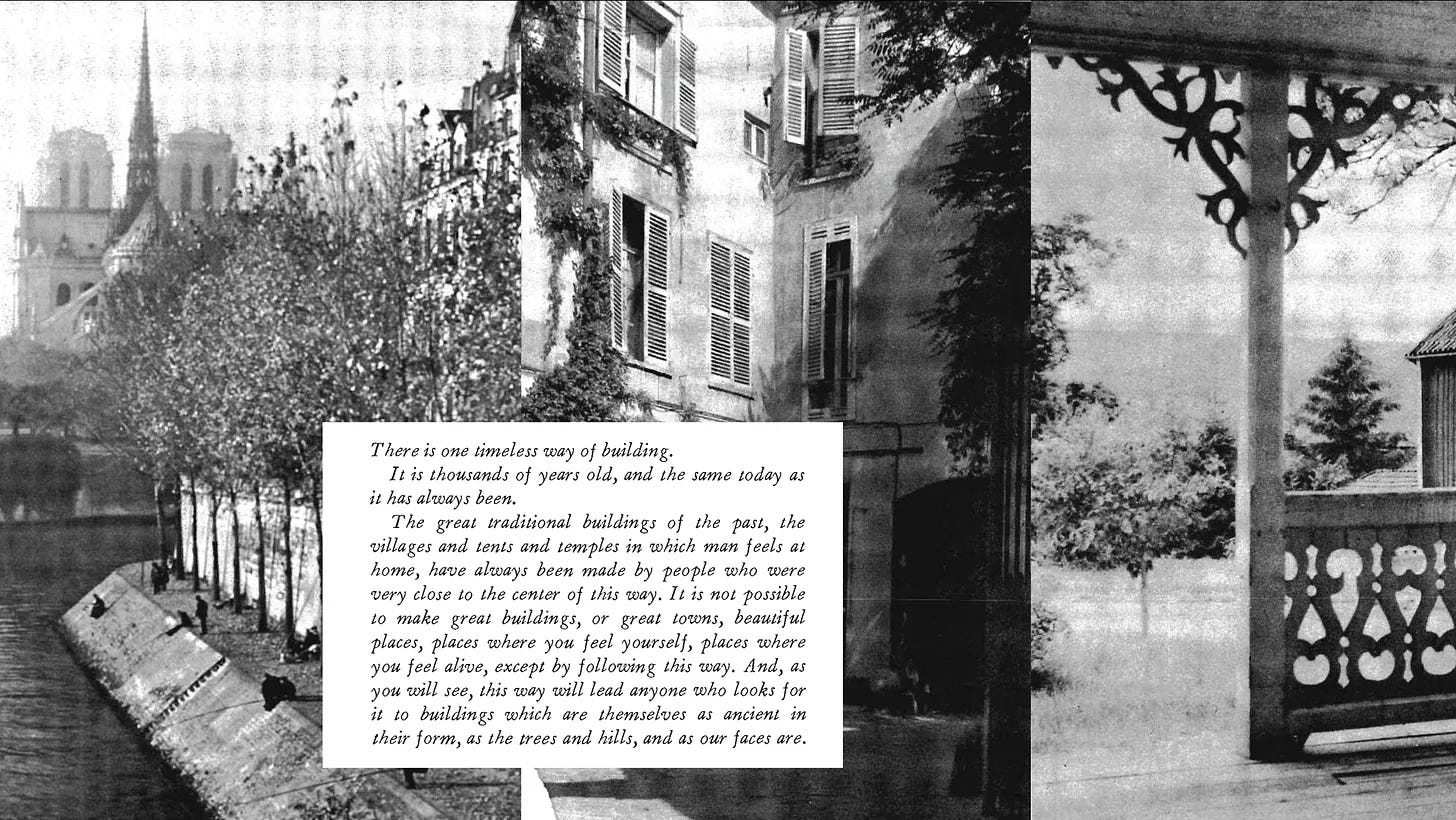
“There is one timeless way of building. It is thousands of years old, and the same today as it always has been. … It is not possible to make great buildings, or great towns, beautiful places, places where you feel yourself, places where you feel alive, except by following this way.” (The Timeless Way of Building, p.7)
“There is a central quality which is the root criterion of life and spirit in a man, a town, a building, or a wilderness. This quality is objective and precise, but it cannot be named.” (ibid., p.19)
A fierce champion of human-centered design, Alexander insisted that beauty and goodness are real, discernible qualities of a built environment – a radical argument at a time when many of his contemporaries, influenced by value-relativism, saw only subjective preferences. Some readers may indeed bristle at his claim that value is real – that some places, buildings, and things possess a quality that makes them objectively better, more beautiful, or more whole and alive than others. Relativism – the view that there is no absolute truth, goodness or beauty – is pervasive in a post-modern world that emphasises individual freedom, and confines value strictly to personal taste.
For Alexander, this “timeless way” of designing wholesome buildings is a creative principle found in all living things, and rests on a nameless quality that is “objective and precise, but which cannot be named”. Its resistance to naming or measurement does not mean that it is not real. Indeed, “words fail to capture it because it is much more precise than any word” (ibid., p.29).
Each building expresses the quality differently; Alexander lists both tents and temples as possessing it. Though it manifests materially, the quality is never reducible to fixed material properties. Value exists as a field of many possibilities and combinations, fundamentally bound to context: “It is never twice the same, because it always takes its shape from the particular place in which it occurs” (ibid., p.26).1
Alexander suggests that while this valuable quality cannot be named, it can be sensed or perceived, although the ability to do so varies. And, it is timeless and universal: most people, even across different cultures, most people are predisposed to recognise it in similar places. His books offer many visual examples.
Alive, whole, comfortable, free, exact, egoless, eternal
“The quality without a name in us, our liveliness, our thirst for life, depends directly on the patterns in the world, and the extent to which they have this quality themselves…patterns which live, release this quality in us.” (ibid., p.122)
What Alexander offers is not a quaint suggestion of built structures that emulate the appearance of living things, but rather a radical view of building as nature; as life – interdependent with humans and human creation, and subject to universal creative principles.
Although the quality can never adequately be captured in language, Alexander ‘circles around’ it, via a collection of patterns that constitute life-affirming systems or spaces. Seven core aspects emerge – all to be felt, rather than measured. Each is essential but insufficient alone; a Venn diagram at the centre of which lies the nameless quality…
Aliveness
The mysterious quality we might sense in the sparkle of an eye; a stirring piece of music; the taut muscles of a cat readying itself to pounce. Found in a thing which is “in tune with its own inner forces”.“Things which are living may be lifeless; nonliving things may be alive”. (ibid., p.29)
Wholeness
The quality of being free from inner contradictions. A system that is at one, and at peace with itself.
Comfortable
A space free from restlessness or tension. Supportive and inviting of deep relaxation and ease. A warm mug of tea that fits snugly in the hand. The chair cushions arranged to support us just so.
Free
A quality of openness and wildness, generated by inner forces, rooted in nature. This freedom counterbalances the tendency of comfort and wholeness towards containment, closure, and stagnation.
Exact
In proper relationship with the forces and constraints of the surrounding world and beings; grounded in reality.
Egoless
Expressing its own nature, rather than the ego-driven will of a creator – yet not altogether erasing the creator…
Eternal
A sense of belonging “among the order of things which stand outside of time.” (ibid., p.38)
Together, these qualities form the basis of a discipline that, once learned, must be transcended for the timeless quality itself to emerge; for the architect to build “as nature does”.
Reintegrating spirit and matter for a truer view of reality
Alexander suggests that without a shift in world-view, his encouragement of a shift towards a more wholesome built environment will fall upon deaf ears. Accordingly, he roots his final major publication, The Luminous Ground, in cosmology. He critiques directly a modern, ‘ultra-mechanistic’ view that reduces the world to ‘meaningless lumps of matter’, leading to hopelessness. While the scientific method has facilitated staggering collective achievement, he argues, its dominance has ultimately impoverished our view of reality; excluding love, aliveness, consciousness and unity from our ‘world-picture’.
“Within this picture, if we ask, What is the point? the only scientific answer that comes back is, There is no point. …Who wants to live, who can live, when we believe that we are…nothing but meaningless machines?” (The Luminous Ground, pp.12-14)
To adopt a world-picture that seriously accounts for fundamental meaning and value is not merely a strategy for feeling better, however, but more consistent with the felt reality of life. He writes: “There are thus two worlds in our minds. One is the scientific world which has been pictured through a highly complex system of mechanisms. The other is the world we actually experience. These two worlds, so far, have not been connected in a meaningful fashion” (ibid., p.13). The sentiment resonates strikingly with the work of Iain McGilchrist, who similarly urges re-integration of our mechanical (left-hemispheric) model of the world with the more truthful (right-hemispheric) experience of the world as whole, spirited, and deeply interconnected.
Alexander’s work is an inspired and impassioned call to attend to the inseparability of our conscious inner world and the material spaces we inhabit. The way we build our homes, towns, cities, and playgrounds both expresses our interior world and shapes it. By attending to the timeless and universal quality of value, we have the power to create healthier, more alive, and more wholesome societies.
“Somehow, the abstract mechanism-inspired world-picture must be modified, transformed, in such a way that it becomes something that has meaning for all of us.”
(The Luminous Ground, p.12)
Explore the field of inner-led change…
A selection of events and opportunities recommended by readers, friends, and allies in the arena of inner-led regeneration.
👋 Help us to showcase the best opportunities and resources: please suggest items to include in the Events, Offers & Links or Jobs Board WhatsApp channels.
Upcoming Events
Second Renaissance Online Conference
📍Online 📅 5-7 December 2025 💸 $45-95
“The Second Renaissance Online conference brings together inquiry and imagination: How can we meet technological disruption with wisdom? How do arts and education nurture resilience and renewal? How do spirituality, health, youth movements, and climate action interweave into a larger story of transformation? How do communities support our values development?”
Confirmed keynote speakers and panelists include: John Vervaeke, Rebecca Henderson, Thomas Hübl, Peter Limberg, Liam Kavanagh, Rufus Pollock and more.
The Wise Agency - online course
📍Online 📅 November 19, 26; December 3, 10 @ 7-9pm ET 💸 Choose a respectful price (recommended $50, but feel free to contribute more or less).
“What exists beyond mere high agency? Join us for a live, experimental series on becoming wisely agentic. … Attendance at all sessions is not required. …
The Wise Agency is a four-part series of presentations and an “inverse course” that aims to draw on participants’ collective wisdom to identify how to accomplish consciously, together. Join Peter Limberg with guests Ayelet Fishbach, C. Thi Nguyen, Paul Millerd, and Scott Britton.”
Coming Home to Place - online festival
📍Online 📅 1-7 December 2025 💸 Video interviews will be free to watch for the first week of December. Donate £30-100 to join the live events and get unlimited access to the interviews.
“Join Gaia Education for an online festival December 1-7 to celebrate our 20-year journey and fundraise for many more years of Transformative Impact. …
Imagine sitting down for an intimate, one-on-one conversation with a leading voice in regenerative practice. That’s the experience we’ve collaboratively created for you. Our recorded interview series brings you directly into the room with pioneering authors, speakers, and practitioners, capturing stories and profound insights from their journeys. Interviews will be released and available from December 1st – 5th. Then, join our Live Events on Saturday 6th and Sunday 7th December.”
Integral Youth Gathering 2026
📍Croatia 📅 23-27 May 2026 💸 €280-380 (depending on accommodation type; includes food)
“Integral Youth Gatherings bring together around 25 young people [between 18 and 42] in a beautiful place in nature to explore personal, spiritual, and relational growth - inspired by Ken Wilber’s Integral Theory.
More than just learning, it’s a space for co-being: practicing new ways of relating, growing together, and embodying transformation in community. As a non-profit and co-created gathering, every activity — from meditations to talks, hikes to music jams — is offered by participants like you. This is a space for us to co-create the world that we want to live in.”
Jobs & Opportunities
Hiring: Financial Steward and Operations Steward at Life Itself
📍Remote with some time in person at Life Itself’s Hubs in France 📅 Apply as soon as possible; applications reviewed on a rolling basis.
“Join the Life Itself team and our mission to cultivate a radically wiser, weller world. Life Itself is seeking two new part-time team members:
A Financial Steward to hold the coherence of our finances, ensuring transparency, care, and alignment with regenerative principles. You’ll oversee budgets, reporting, and systems across our UK and French entities, while helping shape new economic models rooted in integrity and trust.
An Operations Steward to coordinate Life Itself’s day-to-day flow, from events and hub management to systems and culture. You’ll weave coherence across our programs and spaces, helping turn vision into beautifully run realities.”
Call for Proposals: Madness, Mysticism, and the Reenchantment of Psychology
📅 Submission deadline: 4 December 2025
The Society for Theoretical and Philosophical Psychology invite proposals for their Spring 2026 conference (14-16 May, York University, Toronto) on the theme of Madness, Mysticism, and the Reenchantment of Psychology.
“To live in this moment of history is to feel something slipping away. What, precisely, is being lost is difficult to name, though one can sense it in the loneliness that has become the defining mood of our age. We have acquired extraordinary powers of prediction, of surveillance, of manipulation; we can map neural pathways, track the fluctuations of serotonin, and analyze the statistical probabilities of human decision-making. And yet, for all this mastery, we find ourselves unmoored. Our connections to one another are fragile and mediated, our trust in what we once called reality is wavering, and our relationship to the earth itself has been reduced to one of extraction and domination. We have gained technical precision, but we have lost something more fundamental: a sense of depth, mystery, and participation in something irreducible.”
Call for Submissions: Orbital Studies Magazine
📅 Submit by 10 December 2025 to be considered for Issue #0
“Orbital Studies Magazine is a literary science magazine, cultivating space for a more beautiful relationship with the objective world.
Send us your fiction, non-fiction, poetry and visual art pitches on the theme of Ways of Seeing the Objective World. We aim for work which creates a contemplative experience in the reader, shifting their own ways of seeing, bringing them into connection.”
Request for Proposals: Toward a Science of Awakening
📅 Deadline to submit Letter of Intent: 15 December 2025. Deadline for full proposals (by invitation): 1 April 2026.
“At The Consciousness Foundation, we take the view that the persistent, trait-level changes associated with awakening are tractable to scientific study, ready to be investigated with contemporary methods, and hold substantial potential for translation into individual and societal benefit.
We therefore seek proposals for research that makes meaningful progress toward operationalizing a science of awakening: clarifying concepts, developing and validating measures and protocols, conducting rigorous empirical tests, and creating resources that other investigators and practitioners can adopt and extend.”
Second Renaissance
*“Second Renaissance” is one way of framing current times as a period of civilisational crisis and potential renewal – and of pointing to an ecosystem of people and organisations working to catalyse the emergence of a new, regenerative, cultural paradigm. If you recognise terms like metacrisis, Metamodern, Regenerative, Liminal Web, Game B, Integral, conscious evolution and so on, then you’re on familiar ground. Explore the core thesis and theory of change in more detail here.
🌱 Help us to plant seeds of a Second Renaissance. If you want to support the movement, you can:
💬 Share your thoughts in the comments section
🎁 Share this newsletter with a friend
💸 Become a paid subscriber
🎨 Contribute to the Second Renaissance Magazine crowdfunding campaign (Oct-Dec 2025)
Finally, we leave you with some —
Art to nourish the soul…
Curator and artist Sylvie Barbier shares the story behind the Art of Impermanence exhibition which took place in Thénac, France in April 2024. With images and footage of the exhibition, featuring work by Sylvie Barbier, Paz Perlman, Max Pugh, and Luc Waring.
On impermanence:
“The reality of the impermanent nature of life can be both terrifying as well as liberating. The emotions, feeling, thoughts and moment shall pass, the good as well as the bad. Artists regardless of their origin have for centuries been practising presenting the sense of impermanence. In this great moment of change and uncertainty what else to do than to meditate together with the fleeting nature of life. Only by being present to the nature of life can we truly cherish it and touch the bliss of the freedom available with it.”
Thank you for reading the tenth issue of Seeds of a Second Renaissance.
In this way Alexander’s concept of a timeless quality bears strong parallels to the ‘universal grammar of value’ recently proposed by Temple (2023) — more formula than form; allowing manifestations of value to be context-dependent within a shared field. Likewise Hartmann distinguished value itself — ideal and timeless — from ‘goods’ — the concrete bearers of value. See e.g. Frings (2001).